The Benazir Income Support Programme (BISP) is Pakistan’s biggest communal defense initiative, intended to assistance relations alive below the lack line. Millions of women and families depend on this cash help to manage food, teaching, healthcare, and daily incidentals.
But not every family qualifies. The decisive issue is the BISP Poverty Score. This score controls whether a family is eligible, how expenditures are accepted, and whether aid lasts or stops. In 2025, the poverty score has become even more important as the government updates its social protection policies.

BISP Poverty Score 2025
| Field | Details |
|---|---|
| Program Name | Benazir Income Support Programme (BISP) |
| Year | 2025 |
| Survey Tool | National Socio-Economic Registry (NSER) |
| Eligibility Basis | Poverty Score (0–100, via PMT survey) |
| Cutoff Score | Traditionally ≤16.17, now flexible up to 32–40 |
| Payment Amount | Rs. 13,500 quarterly + Taleemi Wazaif (Rs. 1,500–4,000 per child) |
| Application Method | SMS to 8171, Web Portal, or BISP Tehsil Offices |
What Is the BISP Poverty Score?
The BISP Poverty Score is a number between 0 and 100 that reflects a household’s financial condition. It is calculated through the Proxy Means Test (PMT), which measures a family’s living standard wanting demanding salary slips or tier statements.
Instead, survey teams assess:
- Family size and dependents
- Type of house (katcha, semi-pucca, pucca)
- Number of rooms
- Toilet and water facilities
- Ownership of land, livestock, or vehicles
- Education level of family members
- Household items like fridge, TV, motorbike
A lower score = poorer domestic, while a higher score = better off household.
How Is the Poverty Score Calculated?
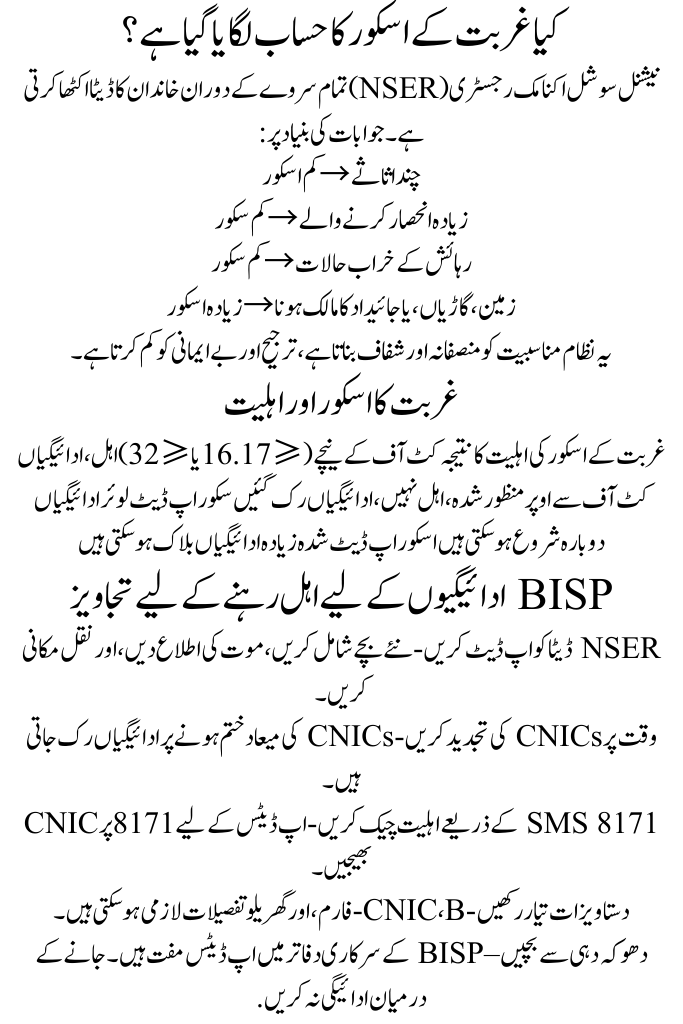
The National Socio-Economic Registry (NSER) gathers family data throughout surveys. Based on responses:
- Few assets → lower score
- More dependents → lower score
- Poor housing conditions → lower score
- Owning land, vehicles, or property→ higher score
This system makes suitability fair and transparent, reducing preference and dishonesty.
Poverty Score Cutoff in 2025
The cutoff score determines who gets BISP payments.
- Traditional cutoff: ≤16.17 (only the poorest families).
- Ehsaas Kafalat update: Increased to 32 or even 40 for widows, orphans, and incapacitated persons.
- Flexible cutoff: Adjusted through rise, floods, or countrywide emergencies.
Poverty Score & Eligibility
| Poverty Score | Eligibility Result |
|---|---|
| Below cutoff (≤16.17 or ≤32) | Eligible, payments approved |
| Above cutoff | Not eligible, payments stopped |
| Score updated lower | Payments may restart |
| Score updated higher | Payments may be blocked |
Why the Poverty Score Matters for Payment Approvals
Your poverty score decides your payment status. If it is below the cutoff, you qualify for Rs. 13,500 quarterly assistance plus Taleemi Wazaif for children. If your score goes above the cutoff, your payments are stopped automatically.

This system ensures that money reaches those who need it most.
Role of NSER in Poverty Score
The NSER database is updated regularly. If your family info is outdated, your score might not reflect your real state.
Examples:
- New child not added → score remains high.
- Family member’s death not updated → score leftovers high.
- Income decreases but not reported → you may appear ineligible.
- Address change not updated→ delays in payments.
Always visit the BISP Tehsil Office to update your NSER data.
Real-Life Examples
- Shazia’s Case – A widow in a katcha house with three broods scored 12, making her eligible. She usages her stipend for food and school fees.
- Imran’s Case – A laborer with a semi-pucca house and bike counted 27. Initially ineligible, but when the cutoff expanded to 32, he qualified.
💡 These examples show how even small changes in score can alteration a family’s fate.
Tips to Stay Eligible for BISP Payments
- Update NSER data – Add new children, report deaths, and relocations.
- Renew CNICs on time – Payments stop if CNICs expire.
- Check eligibility via 8171 SMS – Send CNIC to 8171 for updates.
- Keep documents ready – CNIC, B-forms, and household details may be obligatory.
- Avoid fraud – Updates are free at official BISP offices; don’t pay go-betweens.
Frequently Asked Questions (FAQs)
How do I check my poverty score?
Send your CNIC number to 8171 via SMS. You’ll receive a reply with your suitability status.
Can I improve my poverty score?
You cannot artificially improve it. But if your disorder deteriorates, updating NSER data may lower your score.
Why did my payments stop?
Usually due to:
Poverty score rising above cutoff
CNIC expired
Household data not updated
What if my score is high but I am still struggling?
BISP works on fixed thresholds. However, during rise or crises, cutoffs are expanded to contain more families.
Why the Poverty Score System Works
While not perfect, the poverty score system is the most effective way to find deserving families. It:
- Ensures transparency and fairness
- Reduces favoritism and corruption
- Targets funds to the poorest households
- Expands during crises like floods or inflation
Independent studies confirm that poverty scores have aided reduce extreme lack in Pakistan.
Final Thoughts
The BISP Poverty Score 2025is the strength of Pakistan’s social health system. It decides whether your payments are approved, blocked, or restarted. Relations with lower scores are prioritized, while those with higher scores must wait for threshold changes or update their records.
If you rely on BISP support, make indisputable your NSER data is updated, CNIC is valid, and suitability is checked through 8171 SMS or web portal. This way, your expenditures will continue deprived of break.