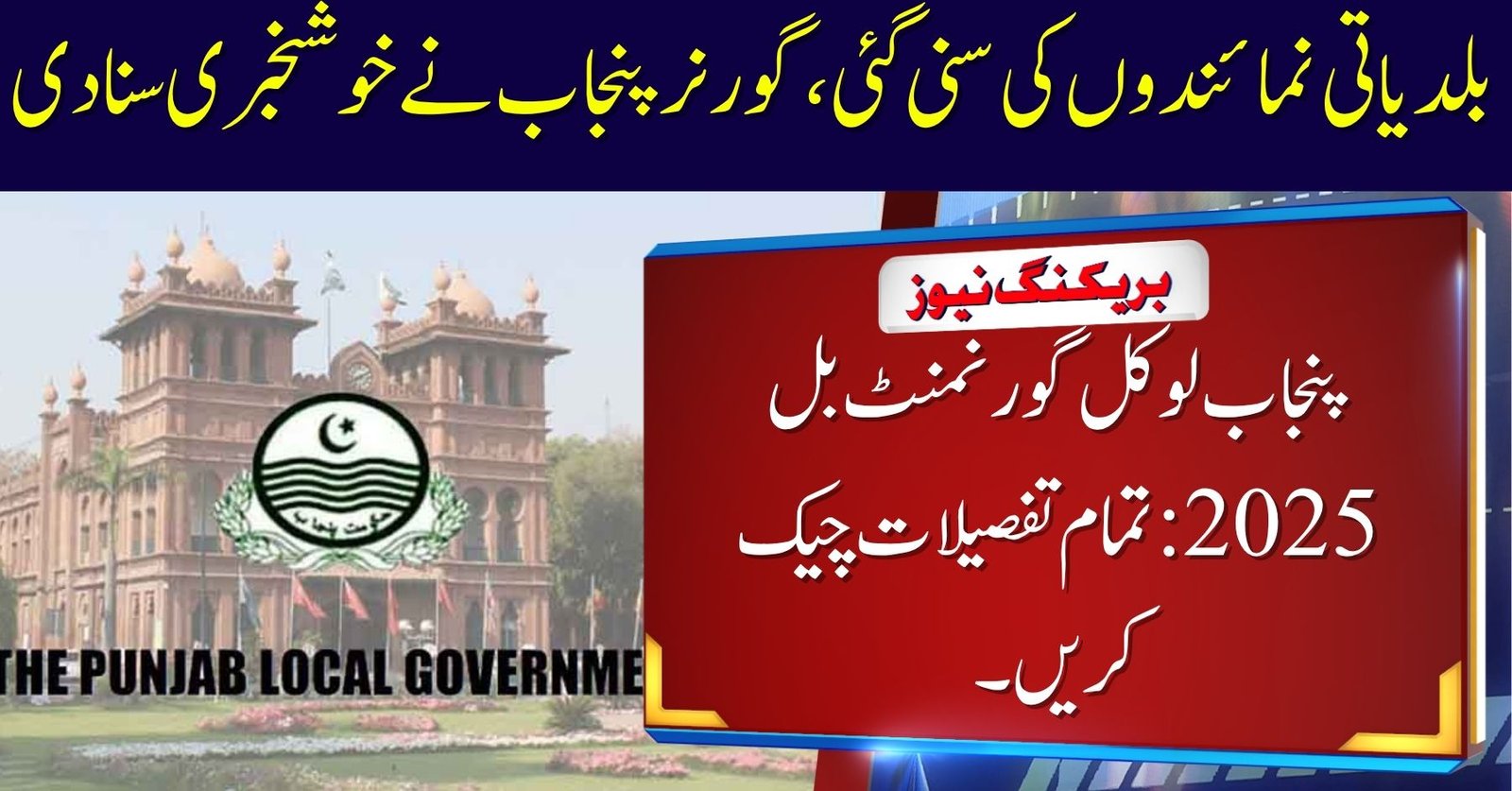
Punjab has lately future the Local Government Bill 2025, aiming to redesign how local reign works in the area. One major change is that Lahore district may be declared fully urban, and new local bodies will have stouter panels at the grassroots level. In this article, I will cover everything from A to Z: the purpose, key topographies, censures, application, legal subjects, how it changes present laws, timelines, and what countries would know.
Punjab Local Government Bill 2025
| Feature / Item | Detail | Notes |
|---|---|---|
| Bill Name | Punjab Local Government Bill 2025 (Bill No. 26 of 2025) | Introduced in Punjab Assembly |
| Date Introduced | 7 March 2025 | According to Punjab Assembly records |
| Scope | Entire Punjab | Changes local government structure for all districts |
| Major Proposal | Lahore district to be fully urban | Town corporations, change in councils |
| Application / Implementation | Offline & legal enactment | Once passed by Assembly and signed by Governor |
| Key Powers | Local tax collection, budget making, public works, PPP projects | Delegated to Union Councils, District Authorities |
Background & Why Punjab Needs This Bill
Punjab has seen several changes in local management laws ended past years. The government claims that to make governance closer to people, there must be more power at Amalgamation Assembly and area levels. Past laws had overlaps, confusion, and many powers central. This new Bill intends to correct that.

Also,Punjab Local Government Bill elections have been pending below old acts. With this new law, new delimitations of limits will happen, and votes might be held below the new scheme.
Key Provisions & Features of the Punjab Local Government Bill
Structure of Local Government
- The bill restores Union Councils at local level. Each Union Council will correspond to one or more census blocks.
- In areas with population over 700,000, Town Corporations will be formed.
- District Authorities / District Committees will exist, and roles are shared between elected legislatures and directorial officials.
Powers, Functions & Finance
- Tax, fees, fines: Local governments (Union Councils, District Authorities) will have power to levy and collect local taxes, fees, and fines.
- Budgets: Union Councils can prepare and approve their budgets.
- Public works and services: Responsibilities include roads, water, drainage, sanitation, street lighting, markets, public toilets, cleaning of public places, management of slaughterhouses.
- Public-private partnerships (PPP): Local governments may run projects in partnership with private sector.
- Community Based Organisations (CBOs): Bill includes provisions for forming CBOs. 20% of development funds may be allocated to CBOs; 80% by government.
- Tax appeals & oversight: Citizens can appeal local tax decisions within 45 days. The commission has authority to suspend unfair taxes.
Administrative Powers & Role of Deputy Commissioners
- Deputy Commissioners (DCs) will be members of all district authorities, though the chairmanship will lie with elected members.
- DCs may act as co-chairpersons in district committees.
- Some critics say this gives DCs too much control, potentially undermining democratic authority.
Governance & Accountability Mechanisms
- Mandatory meetings: Local bodies must hold meetings every two months. If meetings aren’t held, commission can take action.
- Transparency & public information: Local governments must make public information available.
- CBO registration & non-profit status: CBOs must register, cannot distribute profit, term of leadership fixed at one year. On dissolution, assets revert to local government.
Urban / Rural Classification & Lahore
- The bill specifically proposes declaring Lahore district as fully urban.
- Rural versus urban local bodies will have different structures: urban areas may get municipal corporations or town corporations.

Changes to Existing Laws & Structural Shifts
- The new Bill will supersede prior local government acts in Punjab.
- It abolishes district councils, converting them to district authorities. Critics argue this reduces district autonomy.
- The ward system is being altered: each Union Council will have nine elected members; ward-based seats may be removed.
- Elected members will have to join political parties within 30 days of gazette notification.
Timelines, Delimitations & Election Commission Concerns
- The Bill’s draft is with the Punjab Assembly and Standing Committee has recommended approval.
- After the Bill, delimitation of new constituencies will be carried out, with district administration assisting the Election Commission (ECP).
- The ECP has flagged concerns: local government laws in Punjab have changed multiple times, causing delays in elections.
- Legal disputes are possible between provincial government and ECP on whether elections under old or new act should be held.
Benefits & Risks / Criticisms
Potential Benefits
- Devolution: Giving more administrative and financial power to local tiers
- Local accountability: Citizens have closer access to decision-makers
- Better service delivery: Roads, water, sanitation managed locally
- Citizen participation: CBOs, local tax appeals, transparency mechanisms
- Tailored development: Local bodies understand local needs
Major Criticisms / Concerns
- Over-powering DCs / bureaucracy: Some fear DCs will dominate despite elected bodies.
- Reduced autonomy of district councils: Critics say this weakens district level governance.
- Frequent legal changes: Punjab’s local government law has changed often—leading to instability.
- Possibility of conflict with ECP: Elections under new law may face legal challenges.
- Capacity / resource constraints: Local bodies may lack funds, skilled staff, or infrastructure to deliver services.
What Citizens Should Know & How It Affects You
- If you live in Lahore, your area may come under urban / municipal governance rather than rural local body.
- Your Union Council will have more authority to levy small taxes, manage development, and approve budgets.
- You can appeal unfair local taxes via the commission within 45 days.
- You can participate in CBOs and benefit from 20% participatory development funding.
- Local governments will manage day-to-day services like water, sanitation, roads, garbage, lighting, and public toilets.
- Meetings will be regular (every two months), so your representatives should be more accountable.
Implementation Challenges & What Will Decide Success
- The success depends on capacity building: training, staffing, finances
- Coordination with provincial / federal levels: overlap of functions must be resolved
- Transparent and fair delimitations to avoid gerrymandering
- Adequate funding: local bodies must get fair share of budget
- Public awareness: citizens must know their rights, taxes, and complaint avenues
(FAQs)– Punjab Local Government Bill 2025
Is this Bill final and enforceable now?
The Bill (No. 26 of 2025) has been familiarized and approved by Stand-up Committee. It currently expects full Assembly approval and Governor’s acquiescence.
When will local elections take place under this new system?
After delimitations and final passage of law. Some bases expect elections advanced in 2025.

How does this change affect existing local bodies?
Existing local bodies under older acts will be melted or restructured underneath the new outline. The new law dominates earlier ones.
Can local bodies collect all types of taxes?
They can collect certain local taxes, fees, fines as per law. Major taxes (income tax, sales tax) remain with federal/provincial governments.

What is the role of CBOs?
CBOs will be registered, non-profit, will receive a share in growth projects, and act as community-level governments to screen or assist local work.
Conclusion
Punjab Local Government Bill 2025 is a bold effort to reimagine supremacy in the area. It seeks to devolve party-political, administrative, and financial powers to the grassroots while redefining roles of elected and managerial officials. Declaring Lahore fully urban, setting up Town Corporations, giving Union Councils tax and economical authority, integrating CBOs, and building accountability are all ambitious steps. But success be contingent on fairness in votes, honest execution, resource distribution, and overcoming confrontation from government.