

Federal Board Raises Passing Marks
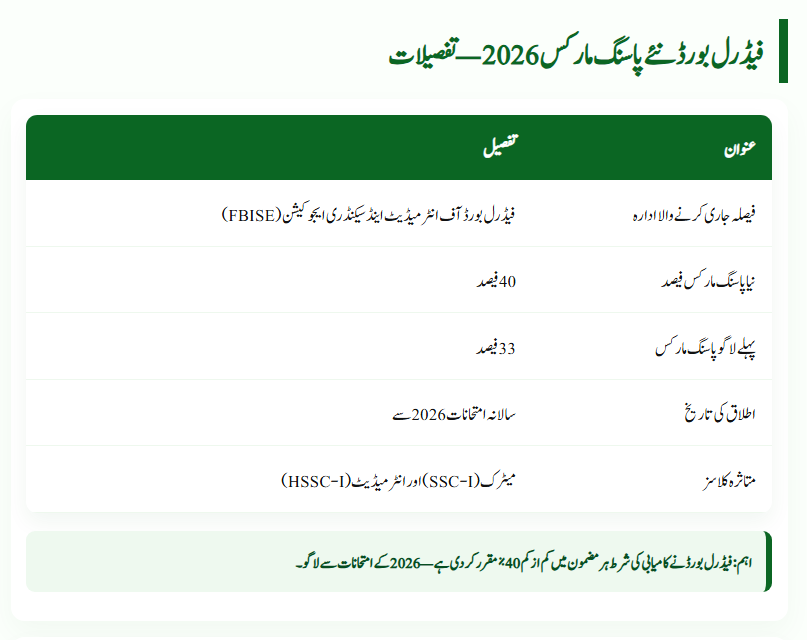
Education is the foundation of every nation — but without quality, that foundation becomes weak. A major development in Pakistan’s education system has caught the attention of thousands of students and parents. The Federal Board of Intermediate and Secondary Education (FBISE) has officially announced an increase in the minimum passing marks from 33% to 40%, starting from the 2026 annual examinations.
This decision aims to improve students’ academic performance and bring the local education system closer to international standards. The new rule will apply to students appearing in SSC-I (Matric Part-I) and HSSC-I (Intermediate Part-I) exams. Let’s explore why this decision was made, what it means for students, and how they can prepare for it effectively.
Key Details
| Category | Details |
| Announced by | Federal Board Raises Passing Marks |
| New Minimum Passing Marks | 40% |
| Previous Passing Marks | 33% |
| Effective From | Annual Exams 2026 |
| Applicable Levels | SSC-I (Matric Part-I) and HSSC-I (Inter Part-I) |
Why Did the Federal Board Increase the Passing Marks?
According to the Federal Board, the decision to raise the passing marks from 33% to 40% was made to improve educational standards and encourage students to study more seriously.in most countries around the world, a 40–50% score is considered the minimum threshold for passing a subject.
The Inter-Board Coordination Commission (IBCC) recommended this change to standardize grading and evaluation across all educational boards in Pakistan. This move shows that the government and education sector now want to focus on true learning rather than just allowing students to pass easily.

Old vs New Passing Marks Comparison
| Exam Level | Old Passing Marks | New Passing Marks |
| Matric (SSC-I) | 33% | 40% |
| Intermediate (HSSC-I) | 33% | 40% |

What Does This Mean for Students?
At first glance, a 7% increase might not seem like much — but for students, it’s a big change. They will now need to study harder and focus more on understanding concepts rather than rote memorization. Teachers believe this will help improve students’ conceptual clarity and discipline.
Parents, too, should see this as a wake-up call to take more interest in their children’s studies and provide a better learning environment at home.
How Can Students Prepare for Federal Board Minimum Passing Marks 2026?
If you’re appearing in the 2026 Federal Board Raises Passing Marks, here are a few important tips to help you succeed:
- Study at least 3 hours daily and maintain a consistent routine.
- Solve past papers to understand the question pattern.
- Join group studies or tuition sessions for subjects you find difficult.
- Improve your time management so you can cover all subjects properly.
- Seek guidance from teachers — they know what the board focuses on.
By following these steps, students can easily adapt to the new system and achieve higher marks.
Students’ and Parents’ Reactions
The new policy has received mixed reactions. Some parents feel that increasing the passing marks will add unnecessary pressure on students. However, many education experts believe that this step will help improve academic performance and discipline. Students have also expressed that if the syllabus and exams are fair and clear, they are ready to accept this challenge.

Impact of Federal Board Minimum Passing Marks 2026 on Education Quality
The decision is expected to have a positive impact on education quality. Schools and teachers will need to improve their teaching methods to help students meet the new standards. This Federal Board Raises Passing Marks policy isn’t just a rule — it’s a reformative step that will strengthen the educational foundation of future generations.
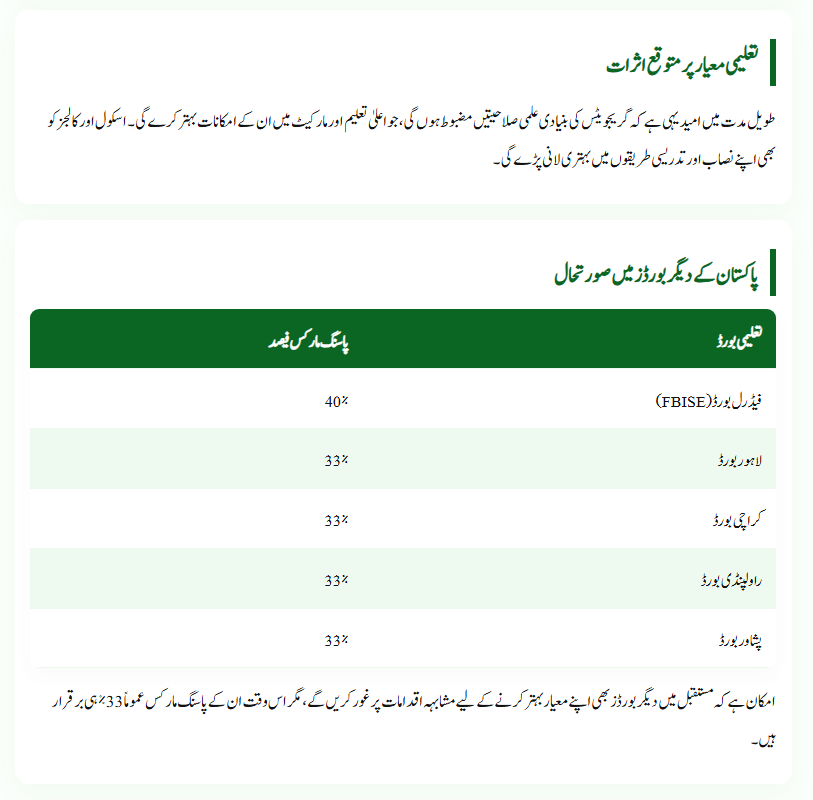
Passing Marks in Other Pakistani Boards
| Education Board | Minimum Passing Marks |
| Federal Board (FBISE) | 40% |
| Lahore Board | 33% |
| Karachi Board | 33% |
| Rawalpindi Board | 33% |
| Peshawar Board | 33% |
It’s expected that other boards may also follow the Federal Board’s example in the coming years to improve education standards nationwide.
Conclusion
The Federal Board Raises Passing Marks 2026 policy is a bold and positive step toward improving Pakistan’s education system. It encourages students to work harder and develop a deeper understanding of their subjects. While the new rule may seem challenging at first, it will ultimately help create a stronger, smarter generation of learners.

Students, teachers, and parents all have a role to play in making this transition smooth and successful. This change marks the beginning of a new era in Pakistan’s education — one focused on quality, discipline, and true learning.
FAQs
1. When will the new passing marks policy take effect?
It will be implemented from the 2026 annual examinations for SSC-I and HSSC-I students.
2. What were the previous passing marks before this change?
Previously, students had to score 33% in each subject to pass.
3. Why did the Federal Board increase the passing marks to 40%?
The decision was made to improve academic standards and bring them in line with international benchmarks.
4. Will this policy apply to all classes?
Initially, it applies to SSC-I and HSSC-I. Later, it may be extended to other grades.
5. How can students prepare for this new requirement?
Students should start focused study routines, practice past papers, and seek help from teachers to strengthen their weak areas.